---
title: "State Of Technology 2025"
author: "Vin Patel"
url: "https://books.vinpatel.com/11/state-of-technology-2025"
---
# Executive Summary
The technology landscape of 2025 is defined by unprecedented AI investment, rapid enterprise adoption, and the emergence of autonomous AI systems that are fundamentally reshaping how businesses operate.
## AI Dominates Investment
AI captured 49% of all global venture funding in 2025, with total investment reaching $202.3 billion—a 75% increase year-over-year. This concentration of capital represents the largest technology investment supercycle since the dot-com era, but with fundamentally stronger underlying economics.
Foundation model companies alone raised $80 billion, with OpenAI ($500B valuation) and Anthropic ($183B) representing nearly 10% of all unicorn value globally.
## Enterprise AI Accelerates
78% of organizations now deploy AI in production, up from 55% in 2023. This isn't experimental adoption—it's operational transformation.
Enterprise GenAI spending surged to $37 billion, a 3.2x increase from 2024. More significantly, the "buy vs. build" equation has flipped: 76% of AI use cases are now purchased rather than built internally, reflecting the maturity of commercial AI products.
## Agentic AI Emerges
Autonomous AI agents represent the next frontier. 79% of organizations report agentic AI adoption, with an average ROI of 171% and task time reductions of 86%.
By 2028, Gartner projects 15% of day-to-day work decisions will be made autonomously by agentic AI—up from 0% in 2024. The agent workforce revolution is no longer theoretical.
---
*The pages that follow provide detailed analysis, data, and strategic guidance for navigating this transformative moment in technology history.*
# The AI Investment Supercycle
*Unprecedented capital concentration reshapes the technology landscape*
## Record-Breaking Investment
2025 marks an inflection point in technology investment history. Global AI investment reached $202.3 billion—more than double the $100 billion invested in 2024 and representing a 75% year-over-year increase.
To put this in perspective: AI now captures 49% of all global venture funding. Nearly half of every venture dollar flows into artificial intelligence.
## The Trajectory (2020-2025)
| Year | Total AI Investment | Generative AI |
|------|--------------------:|--------------:|
| 2020 | $36B | $2B |
| 2021 | $94B | $5B |
| 2022 | $92B | $8B |
| 2023 | $56B | $24B |
| 2024 | $100B | $45B |
| 2025 | $202B | $116B |
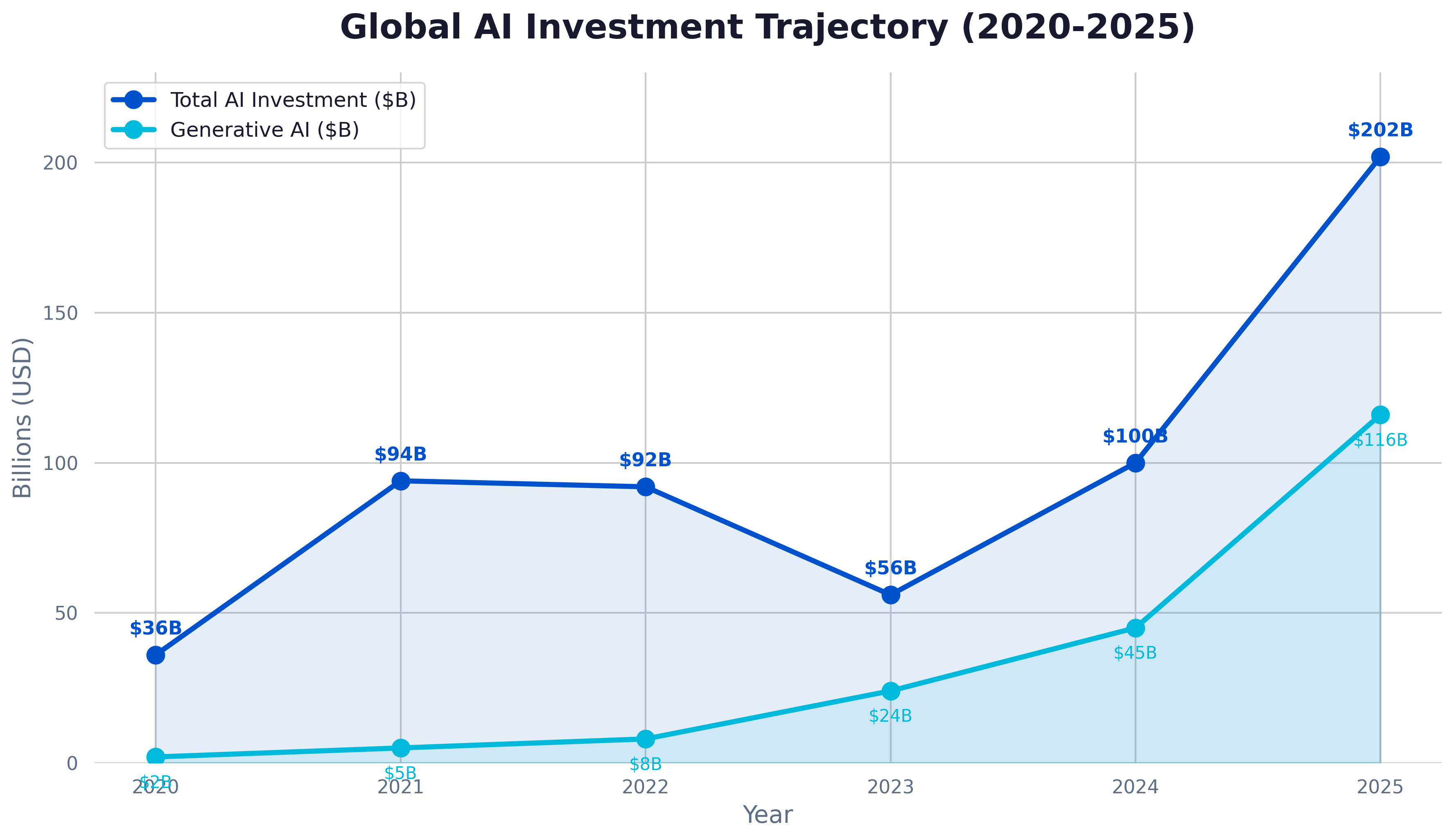
The 2023 dip—often called the "AI winter scare"—proved to be a brief pause before explosive growth. Generative AI investment alone grew from $24B to $116B in just two years.
## Regional Dominance
The United States has established overwhelming dominance in AI investment:
- **United States**: 79% ($159B)
- **China**: 9% ($18B)
- **European Union**: 5% ($10B)
- **United Kingdom**: 4% ($8B)
- **Rest of World**: 3% ($6B)
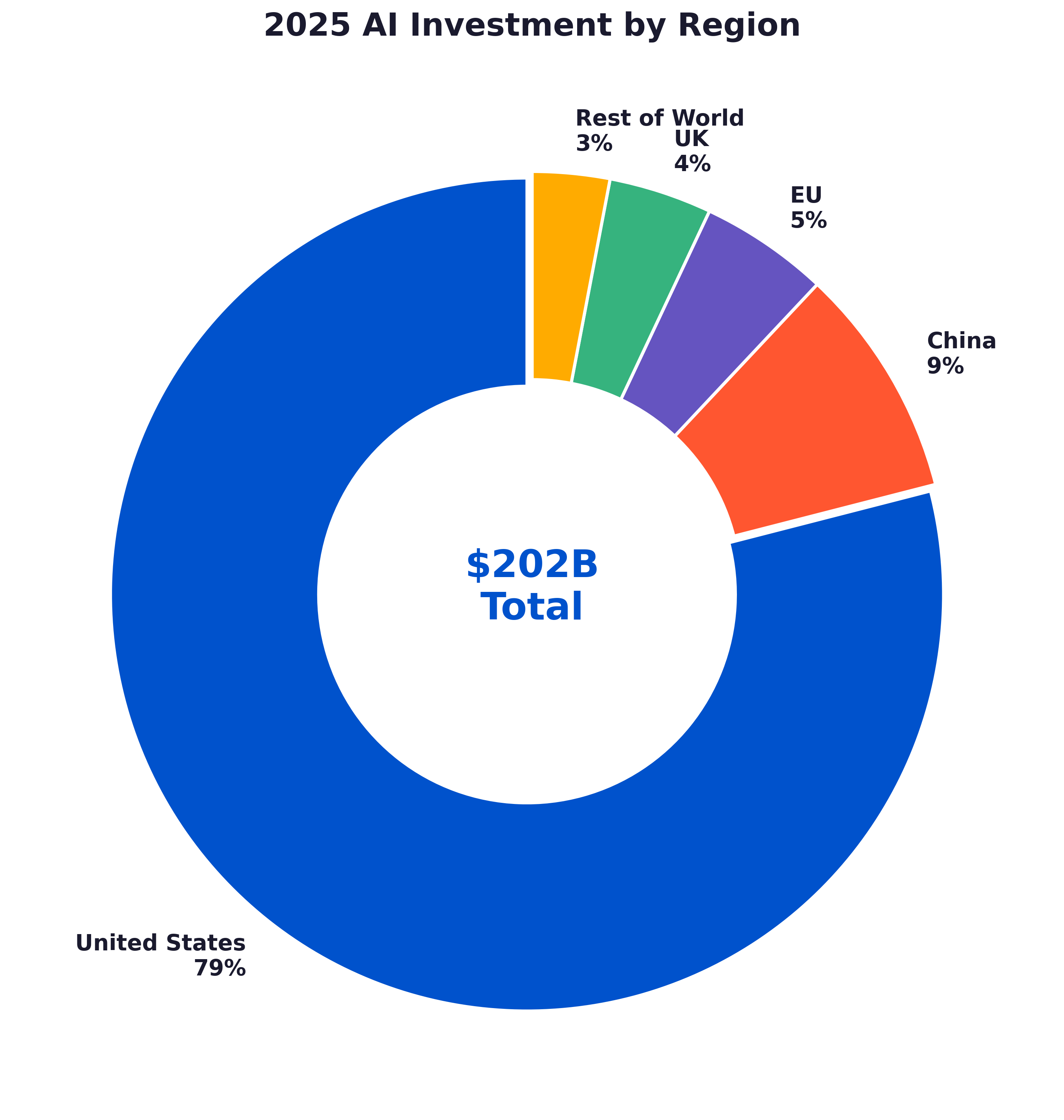
US-based companies captured nearly 8 out of every 10 AI investment dollars globally.
## The Foundation Model Concentration
The most striking feature of 2025's investment landscape is the concentration at the top:
**OpenAI** reached a $500 billion valuation—making it the most valuable private company in history.
**Anthropic** achieved a $183 billion valuation, positioning it as the clear second player in foundation models.
Together, these two companies represent nearly 10% of all unicorn value globally. Foundation model companies raised $80 billion in 2025—40% of total AI funding.
---
> **Key Insight**: This isn't speculative investment. These valuations are backed by explosive revenue growth. OpenAI's annualized revenue reached $12.7 billion with 800 million weekly active users. The fundamentals are real.
---
## What This Means
The AI investment supercycle signals that major institutional investors have reached consensus: AI represents a generational technological shift comparable to the internet itself. Capital is flowing accordingly.
For enterprises, this means:
1. **Innovation velocity will accelerate** — Well-funded AI companies will ship improvements rapidly
2. **Consolidation is coming** — Expect M&A activity as leaders acquire capabilities
3. **Talent competition intensifies** — AI talent remains the scarcest resource
4. **Infrastructure demands grow** — Data centers, chips, and energy become strategic assets
# Enterprise AI Transformation
*From experimentation to production-scale deployment*
## The Adoption Acceleration
Enterprise AI has crossed the chasm. What was experimental in 2023 is now operational in 2025.
| Year | Any AI Use | Generative AI |
|------|----------:|--------------:|
| 2023 | 55% | 33% |
| 2024 | 72% | 65% |
| 2025 | 78% | 71% |
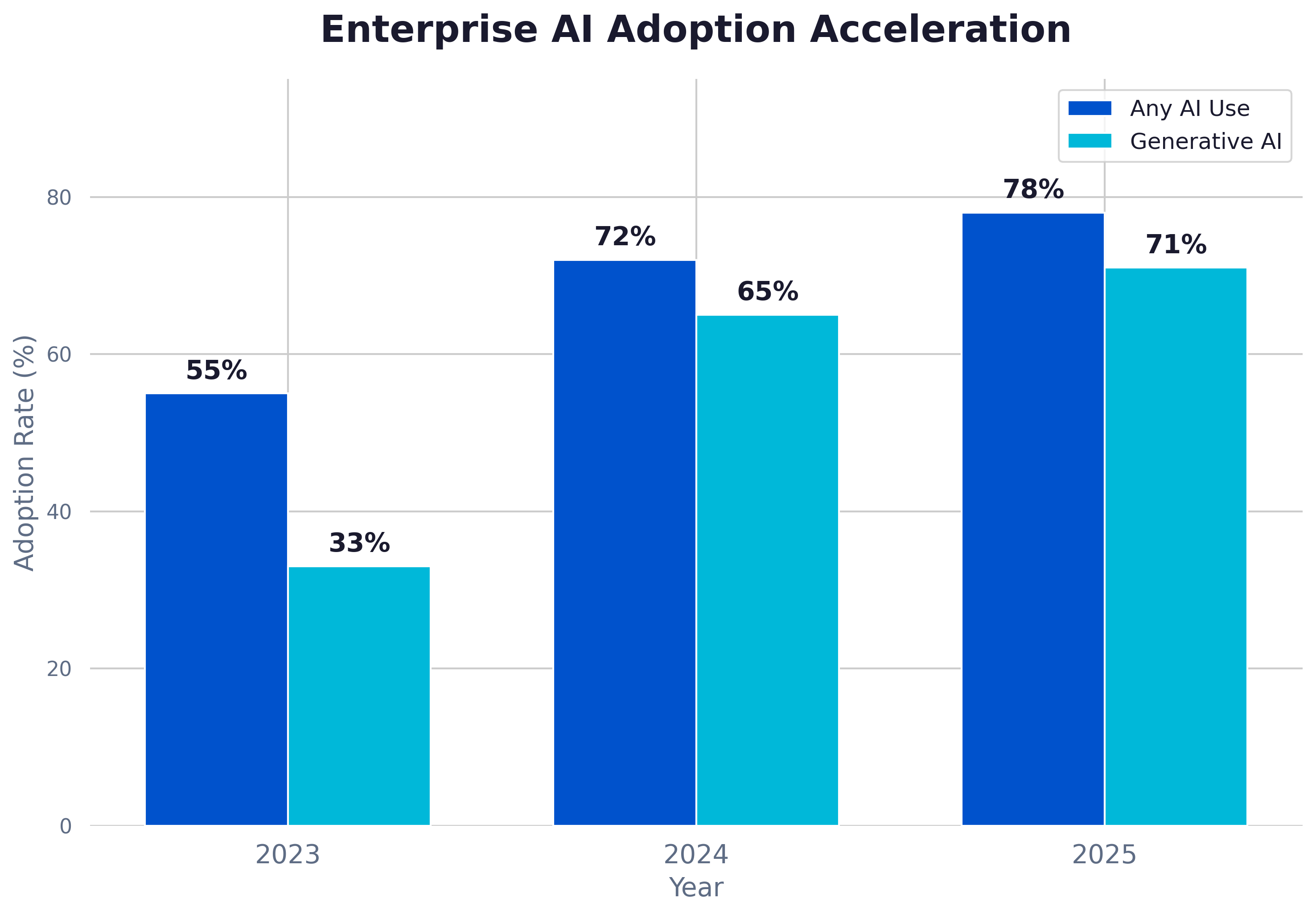
The jump from 55% to 78% in just two years represents the fastest enterprise technology adoption in modern history—faster than cloud computing, mobile, or even the internet.
## Spending Trajectory
Enterprise GenAI spending tells an even more dramatic story:
| Year | Spending |
|------------------|----------|
| 2023 | $1.7B |
| 2024 | $13.8B |
| 2025 | $37B |
| 2026 (Projected) | $52.2B |
| 2027 (Projected) | $93.9B |
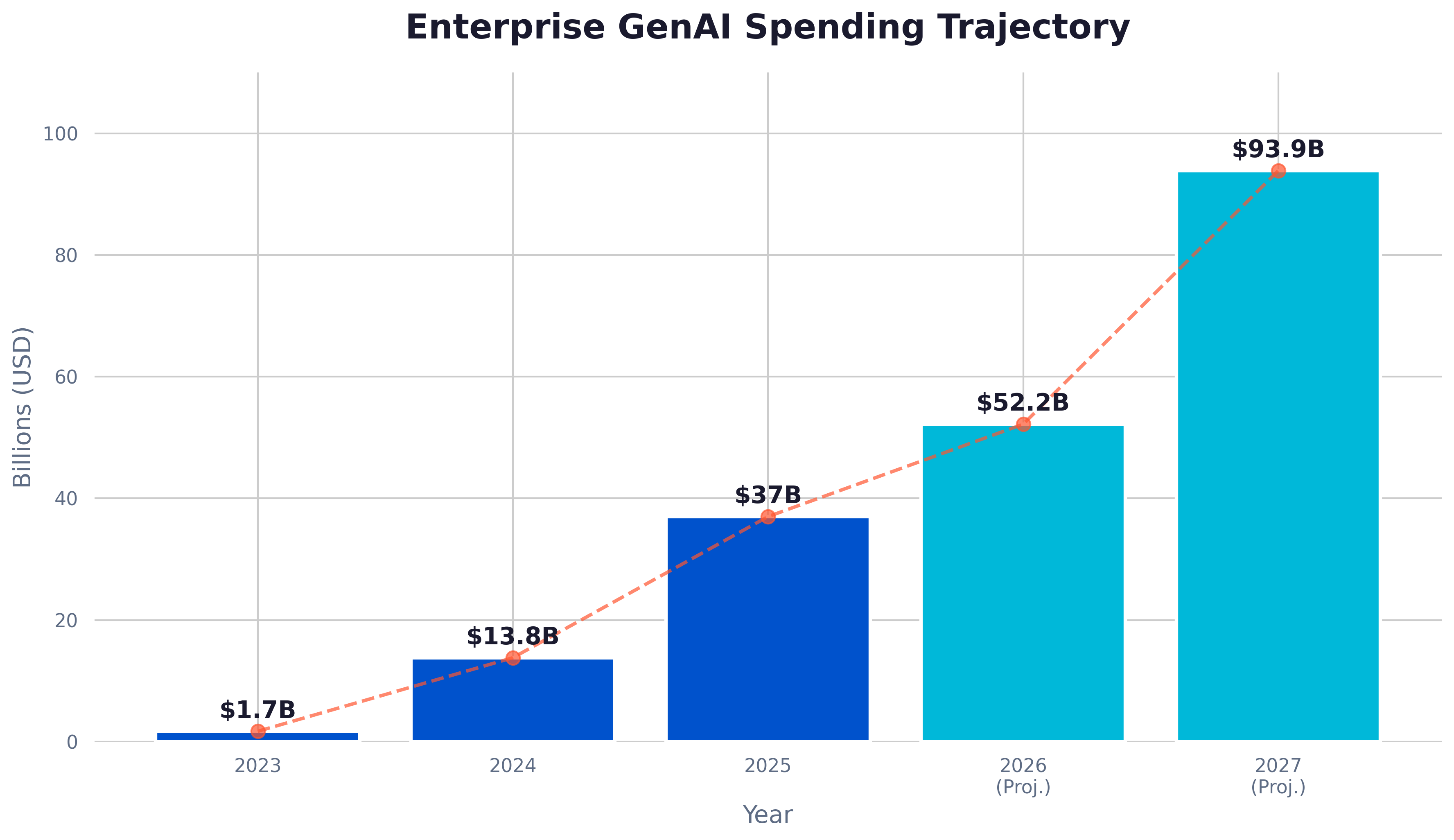
From $1.7 billion to $37 billion in two years—a 21x increase. Projections suggest this will reach nearly $100 billion by 2027.
## AI Implementation by Department
AI adoption varies significantly across organizational functions:
| Department | Adoption Rate |
|------------------|--------------|
| IT | 36% |
| Marketing | 28% |
| Operations | 23% |
| Sales | 18% |
| Customer Service | 15% |
| R&D | 13% |
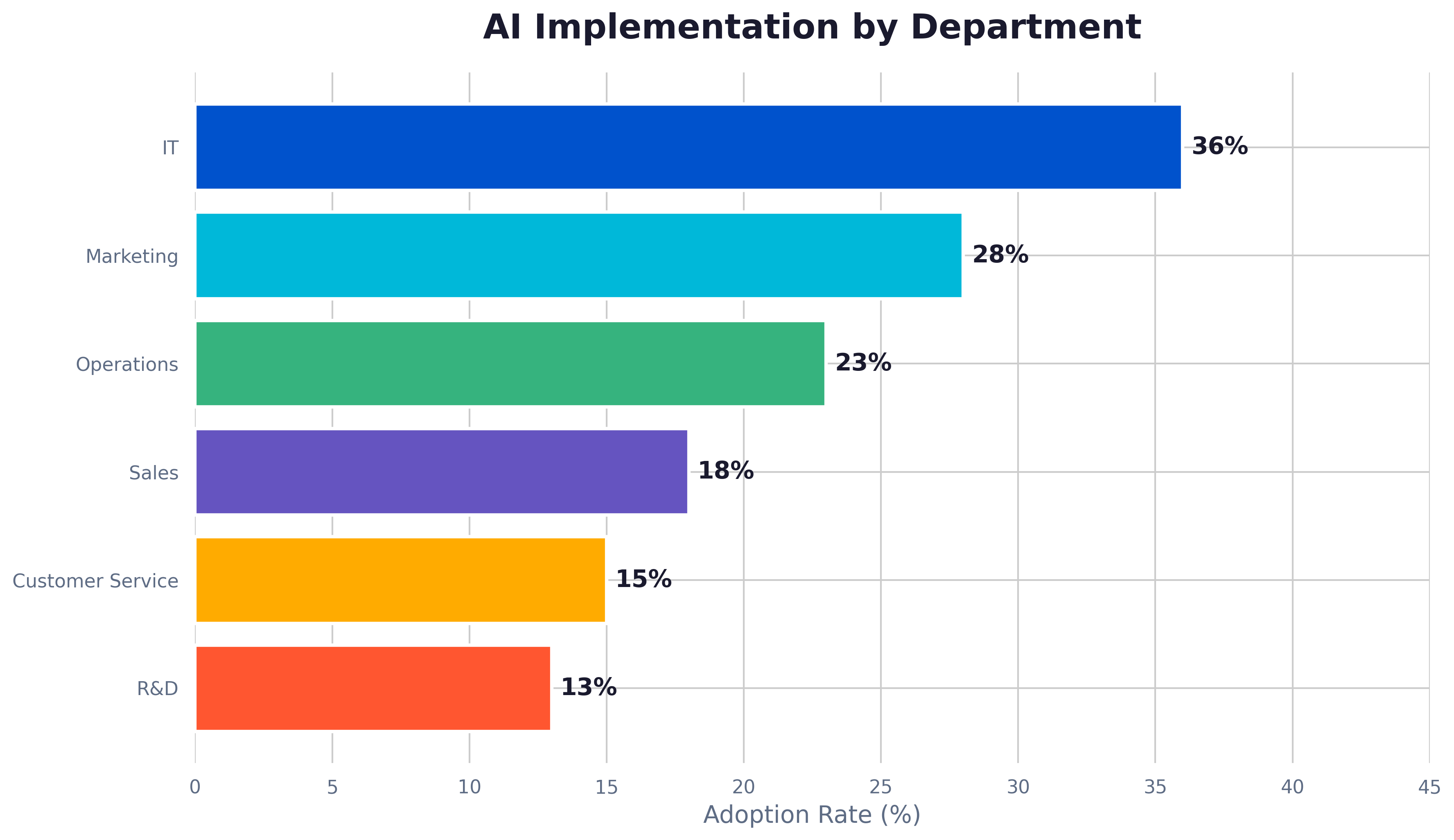
IT leads adoption—unsurprisingly, as technical teams are best positioned to evaluate and deploy AI tools. Marketing follows closely, driven by content generation and personalization use cases.
The opportunity: Sales, Customer Service, and R&D remain under-penetrated. These departments represent significant automation potential that many organizations haven't yet captured.
## The Buy vs. Build Shift
Perhaps the most significant strategic shift in 2025 is the reversal of the build vs. buy equation.
**2024**: 47% of enterprise AI solutions built internally
**2025**: Only 24% built internally—76% are now purchased
This dramatic flip reflects three realities:
1. **Commercial AI products have matured** — Off-the-shelf solutions now match or exceed internal capabilities
2. **Build costs have exploded** — Recruiting AI talent, managing infrastructure, and maintaining models is expensive
3. **Speed matters** — Purchasing gets you to production in weeks, not years
---
> **Key Insight**: The era of "we'll build our own AI" is largely over for most enterprises. The competitive advantage has shifted from building AI to *deploying and integrating AI effectively*.
---
## What Separates Leaders from Laggards
Research from McKinsey and Deloitte identifies clear patterns separating AI leaders:
**Leaders:**
- Deploy AI in production (not just pilots)
- Integrate AI into core workflows
- Measure ROI rigorously
- Invest in change management
- Have executive sponsorship
**Laggards:**
- Stuck in perpetual pilot mode
- AI remains siloed in IT
- No clear ROI metrics
- Underinvest in training
- Lack C-suite commitment
The gap is widening. Organizations that haven't operationalized AI by end of 2025 risk falling permanently behind.
# Emerging Technology Markets
*Growth trajectories reshaping the decade ahead*
## Market Size Projections
Beyond current AI adoption, several technology markets are positioned for explosive growth through 2030-2034:
| Technology | 2025 Current | 2030-34 Projection | CAGR |
|-------------------|-------------:|-------------------:|------:|
| AI Software | $244B | $827B | 27.7% |
| Generative AI | $67B | $220B | 29.0% |
| Agentic AI | $7.5B | $199B | 43.8% |
| Quantum Computing | $1.5B | $16.4B | 30.9% |
| Humanoid Robots | $2.9B | $38B | 45.5% |
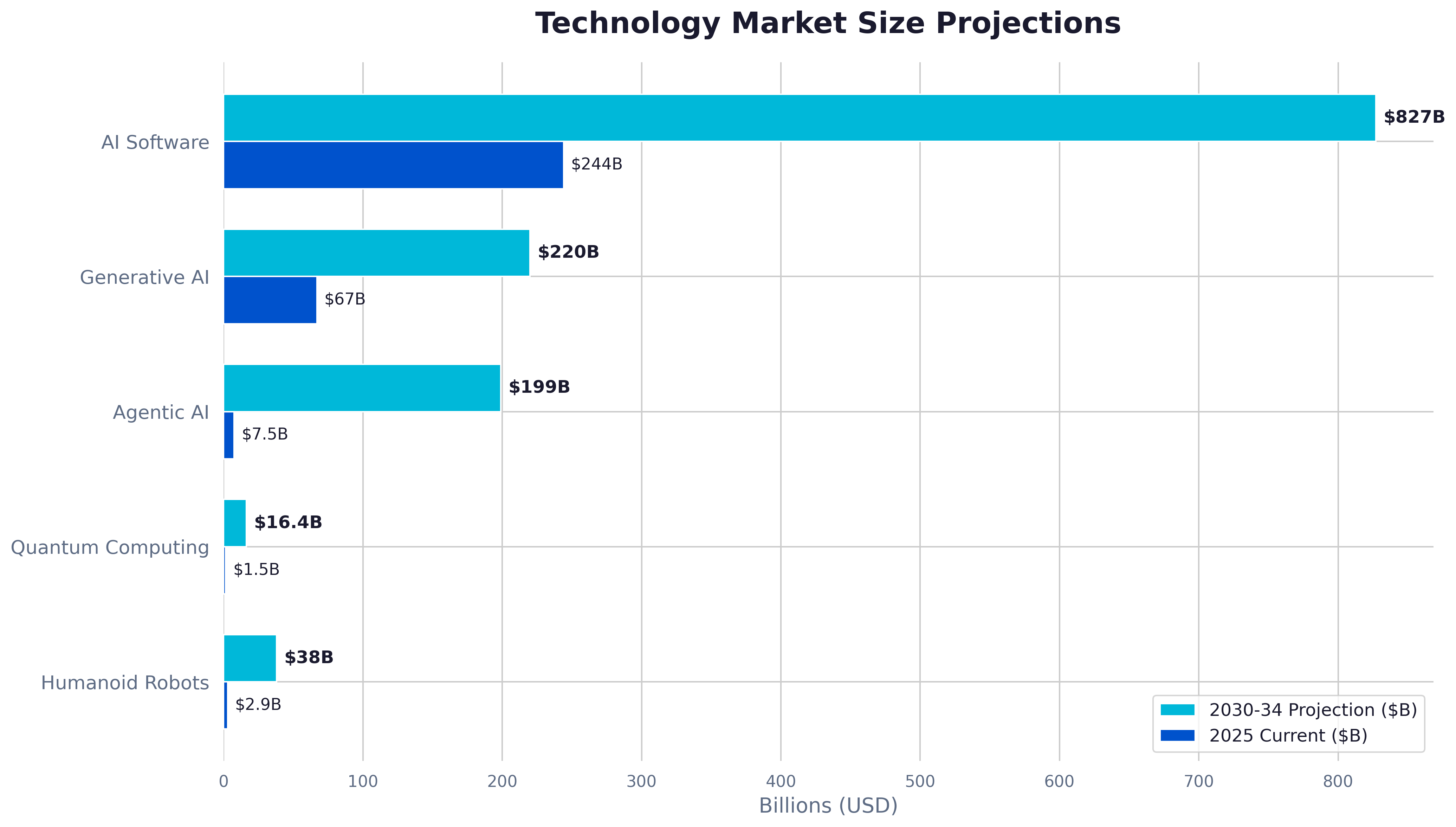
The numbers reveal where the next wave of transformation will come from.
## The Growth Leaders

### Humanoid Robots (45.5% CAGR)
The highest growth sector is perhaps the most surprising: humanoid robots.
Morgan Stanley projects this could become a $5 trillion market by 2050. Tesla's Optimus, Figure AI, and Boston Dynamics are racing to production. China has declared humanoid robotics a national priority.
The convergence of AI (for intelligence), improved batteries (for power), and advanced materials (for dexterity) has made humanoid robots commercially viable for the first time.
### Agentic AI (43.8% CAGR)
Agentic AI—autonomous systems that can plan, reason, and execute complex tasks—represents the next evolution of AI deployment.
Growing from $7.5B to $199B in under a decade, agentic AI will transform how enterprises automate workflows, manage operations, and serve customers.
### Quantum Computing (30.9% CAGR)
Quantum computing remains early-stage but is approaching commercial viability for specific use cases:
- Drug discovery
- Financial modeling
- Cryptography
- Materials science
- Optimization problems
First commercial quantum advantage is expected by 2027 in pharmaceutical research.
## What These Numbers Mean
These aren't independent trends—they're converging:
- **AI + Robotics** = Intelligent physical systems
- **AI + Quantum** = Breakthrough computational capabilities
- **Agentic AI + Everything** = Autonomous enterprise operations
Organizations planning for 2030 and beyond should track all three vectors.
---
> **Key Insight**: The 40%+ CAGR in humanoid robots and agentic AI suggests these technologies will move from "interesting experiments" to "operational necessity" within 5 years. Planning should start now.
# AI Capabilities Evolution
*Benchmark improvements and capability breakthroughs*
## Performance Gains (2024 → 2025)
AI capabilities improved dramatically across every major dimension in 2025:
| Capability | 2024 Score | 2025 Score | Improvement |
|-----------------|----------:|----------:|------------:|
| Code Generation | 55 | 75 | +20 points |
| Reasoning | 42 | 70 | +28 points |
| Multimodal | 40 | 70 | +30 points |
| Agent Tasks | 28 | 70 | +42 points |
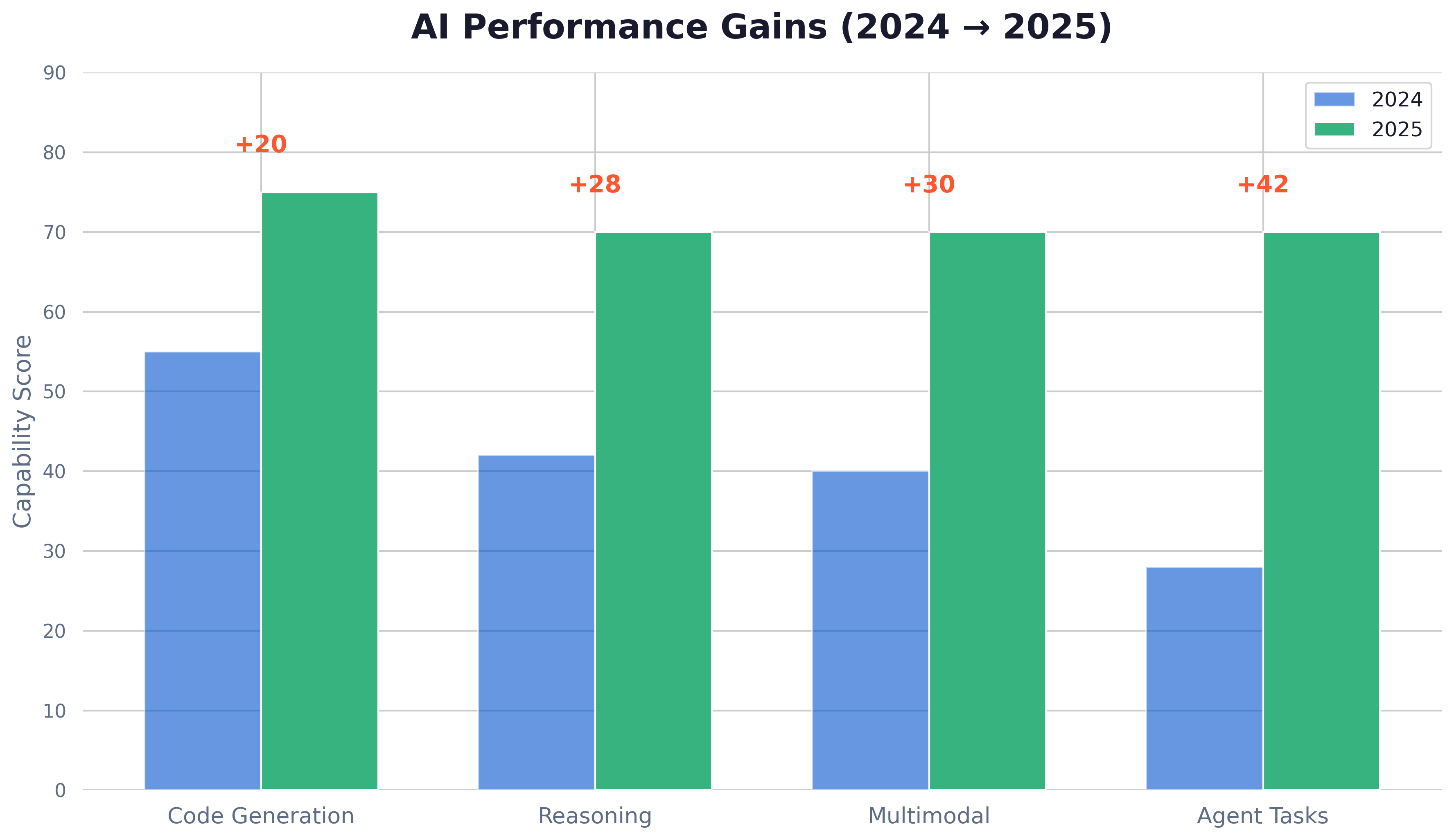
The most dramatic improvement came in agent tasks—the ability of AI systems to autonomously plan and execute multi-step workflows. This capability essentially didn't exist at scale in 2024; by 2025, it's approaching production-ready.
## The Benchmark Saturation Problem
AI capabilities are advancing so rapidly that evaluation frameworks can't keep pace.
In 2024, researchers introduced several new benchmarks designed to challenge frontier AI models:
- **MMMU** (Multimodal understanding)
- **GPQA** (Graduate-level reasoning)
- **SWE-bench** (Software engineering)
Within one year, scores on these "hard" benchmarks rose dramatically:
| Benchmark | 2024 Score | 2025 Score | Improvement |
|-----------|----------:|----------:|-------------:|
| MMMU | 56.8% | 75.6% | +18.8 points |
| GPQA | 41.3% | 90.2% | +48.9 points |
| SWE-bench | 4.4% | 71.7% | +67.3 points |
Benchmarks designed to measure the frontier become saturated within months. This forces constant creation of harder evaluation frameworks—a good problem to have, but one that makes capability assessment challenging.
## Emerging Technology Maturity
Beyond pure AI, related technologies show varying levels of readiness:
| Technology | Maturity | Adoption | Impact Potential |
|------------|:--------:|:--------:|:----------------:|
| Generative AI | High | High | Very High |
| Agentic AI | Medium | High | Very High |
| Quantum Computing | Low | Very Low | High |
| Humanoid Robots | Low-Medium | Very Low | High |
| Brain-Computer Interface | Very Low | Minimal | High |
**Generative AI** is mature and widely adopted—the implementation phase is well underway.
**Agentic AI** has medium maturity but high adoption, suggesting enterprises are deploying despite remaining limitations.
**Quantum, Robotics, and BCI** remain early but carry transformative potential.
---
> **Key Insight**: The +42 point improvement in agent tasks is the headline number. It signals that AI is graduating from "assistant that responds" to "agent that acts." This shift will define 2026.
# The Rise of Agentic AI
*Autonomous systems transform from concept to enterprise reality*
## What is Agentic AI?
Agentic AI refers to AI systems that can:
- **Plan** — Break complex goals into steps
- **Reason** — Make decisions based on context
- **Execute** — Take actions autonomously
- **Learn** — Improve from feedback
- **Persist** — Maintain state across sessions
Unlike traditional AI assistants that respond to individual prompts, agentic systems can handle multi-step workflows with minimal human intervention.
## The Numbers
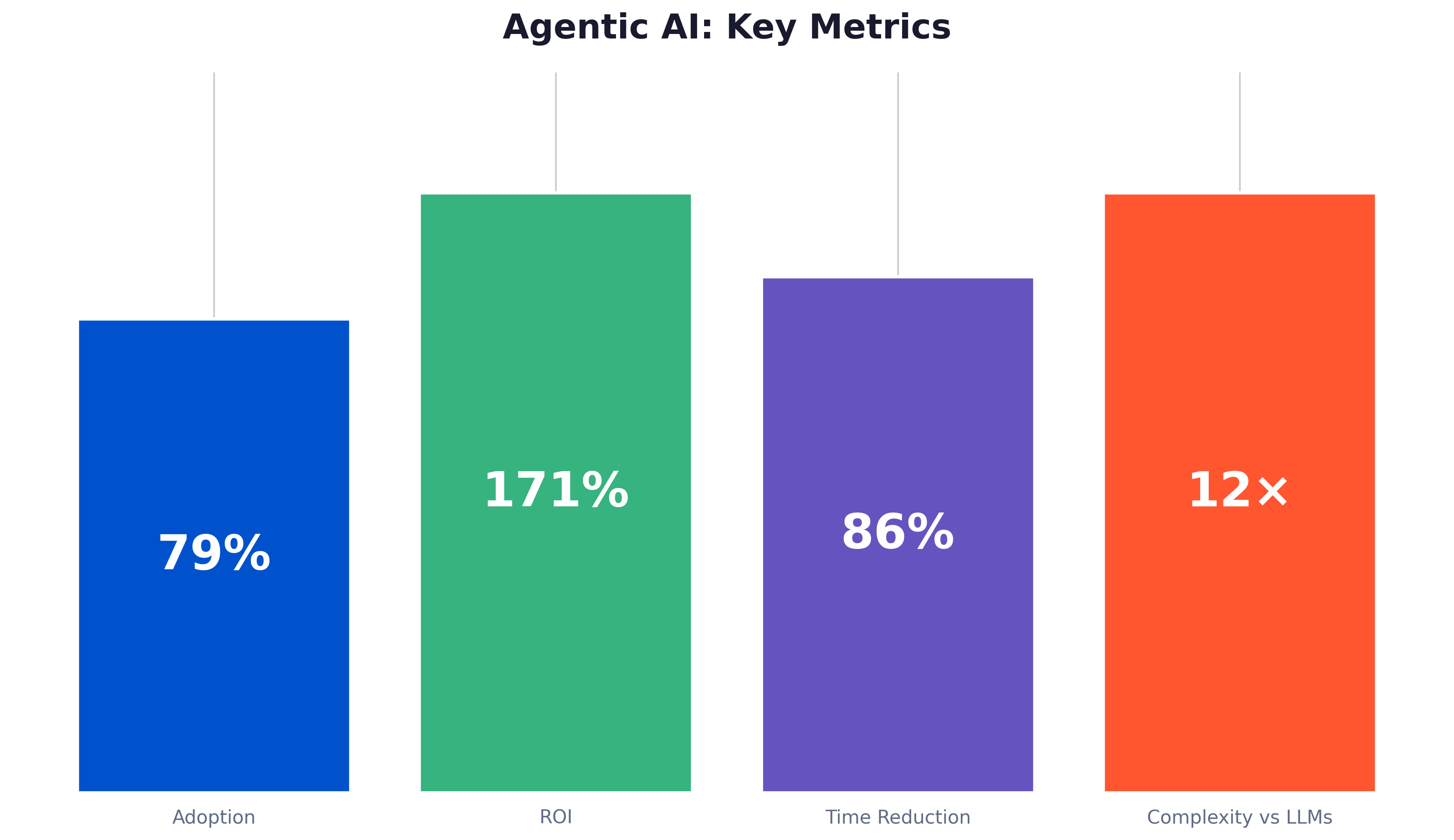
Agentic AI adoption has been remarkably swift:
79%
Organizations with agentic AI adoption
171%
Average ROI reported
86%
Task time reduction
12×
More complex tasks vs traditional LLMs
These aren't pilot metrics—they're production results from organizations deploying agentic systems at scale.
## The Agent Workforce Revolution
Gartner's projection is stark:
> By 2028, 15% of day-to-day work decisions will be made autonomously by agentic AI—up from 0% in 2024.
We're witnessing the birth of a new category of digital worker. Not replacing humans, but augmenting them with autonomous capabilities that handle routine decisions and workflows.
## Current Adoption Patterns
- **45%** of Fortune 500 companies are piloting agentic systems
- **40%** of Fortune 100 firms use Microsoft's AutoGen framework
- Framework usage (AutoGen, LangGraph, CrewAI) is up **920% year-over-year**
## Key Use Cases
Agentic AI is finding traction in:
**Code Development**
- GitHub Copilot Workspace
- Cursor
- Devin (autonomous software engineer)
**Enterprise Workflows**
- Salesforce Einstein agents
- ServiceNow virtual agents
- SAP Joule agents
**Research & Analysis**
- Multi-step research tasks
- Document analysis and synthesis
- Competitive intelligence
**Customer Operations**
- Autonomous customer service
- Complex case resolution
- Proactive outreach
---
> **Key Insight**: The 79% adoption rate with 171% ROI suggests agentic AI has crossed from "interesting technology" to "competitive necessity." Organizations without an agentic AI strategy are falling behind.
# Strategic Outlook: 2026 and Beyond
*Critical trends shaping the next wave of innovation*
The data in this report points to six strategic predictions for 2026 and beyond:
---
## 1. Agentic AI Dominance
**60% of new enterprise AI deployments will include agentic capabilities by end of 2026.**
The shift from assistive to autonomous AI is accelerating. Organizations that master agentic deployment will gain significant operational advantages.
---
## 2. Model Commoditization
**Open-source models will reach parity with proprietary models for 80% of enterprise use cases.**
Llama, Mistral, and other open models are closing the capability gap. This will pressure pricing and shift competitive advantage from "having AI" to "deploying AI effectively."
---
## 3. AI Regulation Wave
**US federal AI legislation will pass, following EU AI Act implementation and 131 state-level laws.**
The regulatory environment is tightening globally. Compliance will become a strategic function, not just a legal one.
---
## 4. Quantum Advantage
**First commercial quantum computing advantage demonstrated in drug discovery by 2027.**
While still early, quantum computing will achieve its first meaningful commercial results within two years. Pharmaceutical and materials science companies should begin preparation.
---
## 5. Humanoid Scale-Up
**Humanoid robot shipments reach 115,000 units globally by 2027, led by China manufacturing.**
The humanoid robotics industry will scale from research to production. Manufacturing, logistics, and elder care are early adoption sectors.
---
## 6. AI Infrastructure Boom
**Hyperscaler AI capex exceeds $300B annually, driving massive data center buildout.**
Microsoft, Google, Amazon, and Meta's combined AI infrastructure investment will reshape energy markets, real estate, and chip manufacturing globally.
---
> **Key Insight**: These six trends are interconnected. Agentic AI requires infrastructure. Regulation shapes deployment. Commoditization accelerates adoption. Leaders will navigate all vectors simultaneously.
# Key Takeaways for Business Leaders
## Immediate Actions (2025)
### 1. Audit AI Readiness
Assess your current AI capabilities against the 78% adoption benchmark. If you're not deploying AI in production, you're behind the majority of enterprises.
Questions to ask:
- What AI tools are in production today?
- What's our AI spend relative to peers?
- Do we have executive sponsorship for AI initiatives?
### 2. Evaluate Agentic Pilots
With 79% adoption and 171% ROI, agentic AI demands attention. Identify three high-value workflows that could benefit from autonomous AI agents.
Starting points:
- Customer service escalation handling
- Data analysis and reporting
- Code review and documentation
### 3. Review Build vs. Buy
The 76% purchase rate suggests commercial solutions have matured. Reassess any internal AI development projects.
Ask:
- Can we buy this capability instead?
- What's the true cost of building internally?
- How much time would buying save?
### 4. Strengthen Data Infrastructure
AI success requires quality data foundations. Audit your data readiness:
- Data quality and cleanliness
- Access and governance
- Integration capabilities
---
## Strategic Planning (2026-2028)
### 1. Prepare for Regulation
EU AI Act compliance deadlines are approaching. US federal legislation is expected. Build compliance into your AI strategy now.
### 2. Develop AI Governance
233 AI incidents in 2024 (up 56.4%) highlight risk management needs. Establish:
- AI ethics guidelines
- Risk assessment frameworks
- Incident response procedures
### 3. Explore Emerging Tech
Quantum computing and humanoid robotics are approaching commercial viability. Assign someone to track developments and identify pilot opportunities.
### 4. Build Agent-Ready Architecture
Multi-agent systems will transform enterprise workflows. Ensure your technology stack can support:
- Agent orchestration
- Tool integration
- State management
- Monitoring and observability
---
## Investment Priorities
| Priority | Rationale |
|----------|-----------|
| **Generative AI Tools** | 71% enterprise adoption, proven productivity gains |
| **Agentic AI Platforms** | 43.8% CAGR, highest growth potential |
| **AI Security & Governance** | Incident rates up 56.4%, regulation imminent |
| **Data Infrastructure** | Foundation for all AI initiatives |
---
## The Bottom Line
The organizations that will lead in 2030 are making AI investments today. The data is clear:
- **$202B** flowing into AI annually
- **78%** of enterprises already deploying
- **171%** ROI from agentic AI
- **43.8% CAGR** in autonomous systems
The question isn't whether to invest in AI. It's how fast you can move.