Emerging Technology Markets
Growth trajectories reshaping the decade ahead
Market Size Projections
Beyond current AI adoption, several technology markets are positioned for explosive growth through 2030-2034:
| Technology | 2025 Current | 2030-34 Projection | CAGR |
|---|---|---|---|
| AI Software | $244B | $827B | 27.7% |
| Generative AI | $67B | $220B | 29.0% |
| Agentic AI | $7.5B | $199B | 43.8% |
| Quantum Computing | $1.5B | $16.4B | 30.9% |
| Humanoid Robots | $2.9B | $38B | 45.5% |
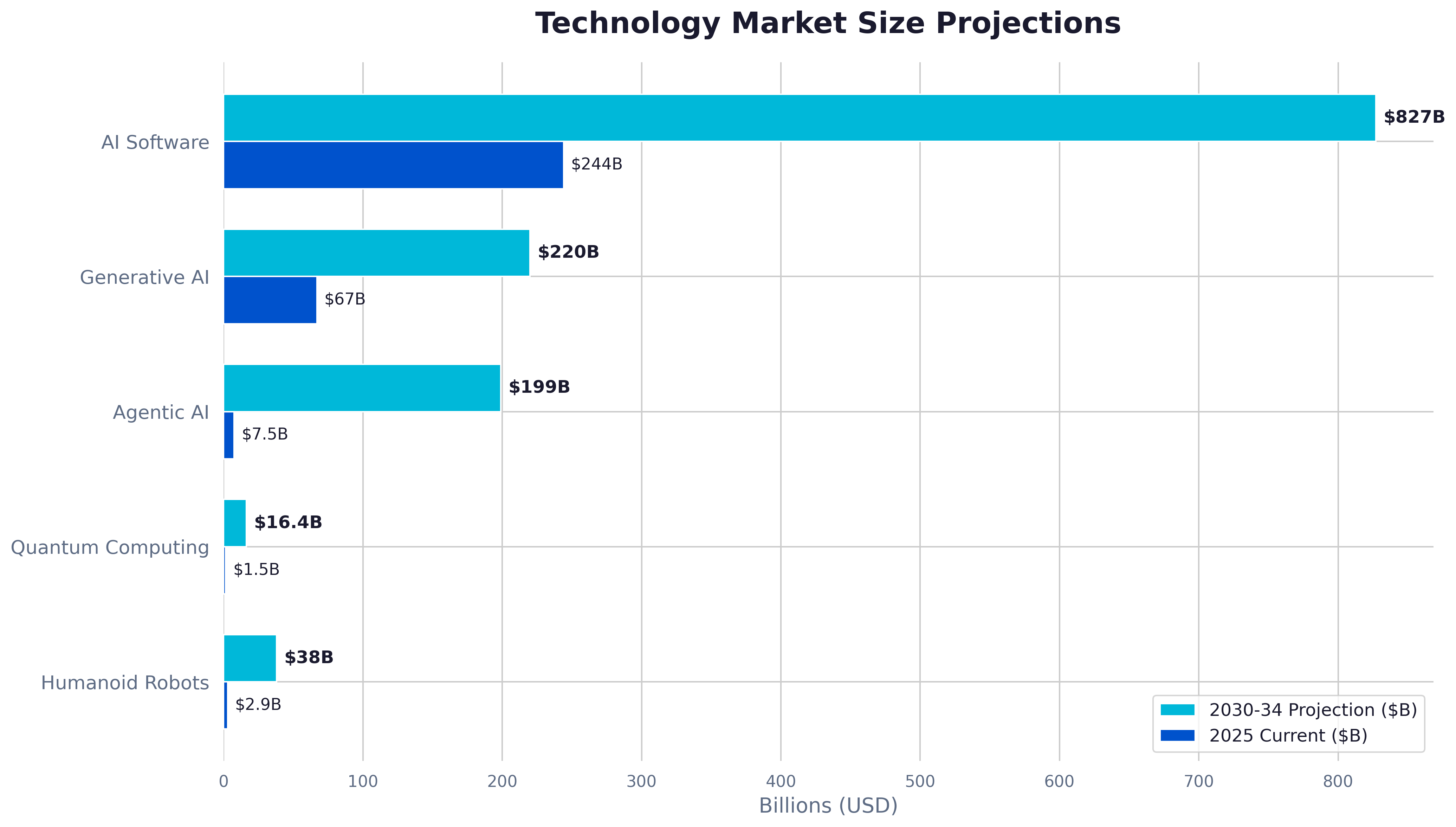
The numbers reveal where the next wave of transformation will come from.
The Growth Leaders

Humanoid Robots (45.5% CAGR)
The highest growth sector is perhaps the most surprising: humanoid robots.
Morgan Stanley projects this could become a $5 trillion market by 2050. Tesla's Optimus, Figure AI, and Boston Dynamics are racing to production. China has declared humanoid robotics a national priority.
The convergence of AI (for intelligence), improved batteries (for power), and advanced materials (for dexterity) has made humanoid robots commercially viable for the first time.
Agentic AI (43.8% CAGR)
Agentic AI—autonomous systems that can plan, reason, and execute complex tasks—represents the next evolution of AI deployment.
Growing from $7.5B to $199B in under a decade, agentic AI will transform how enterprises automate workflows, manage operations, and serve customers.
Quantum Computing (30.9% CAGR)
Quantum computing remains early-stage but is approaching commercial viability for specific use cases:
Drug discovery
Financial modeling
Cryptography
Materials science
Optimization problems
First commercial quantum advantage is expected by 2027 in pharmaceutical research.
What These Numbers Mean
These aren't independent trends—they're converging:
AI + Robotics = Intelligent physical systems
AI + Quantum = Breakthrough computational capabilities
Agentic AI + Everything = Autonomous enterprise operations
Organizations planning for 2030 and beyond should track all three vectors.
Key Insight: The 40%+ CAGR in humanoid robots and agentic AI suggests these technologies will move from "interesting experiments" to "operational necessity" within 5 years. Planning should start now.