 Move Foreword
Open Foreword
Foreword
Machine learning and artificial intelligence have emerged as transformative technologies across industries, from healthcare diagnostics to consumer analytics. However, the reality of these technologies is more nuanced than the widespread enthusiasm suggests.
While machine learning and AI have gained significant attention, they represent early stages in the evolution toward Artificial General Intelligence (AGI). Machine learning occupies the foundational level of this technological spectrum, with deep learning building upon it, and AI encompassing the broader vision of intelligent systems.
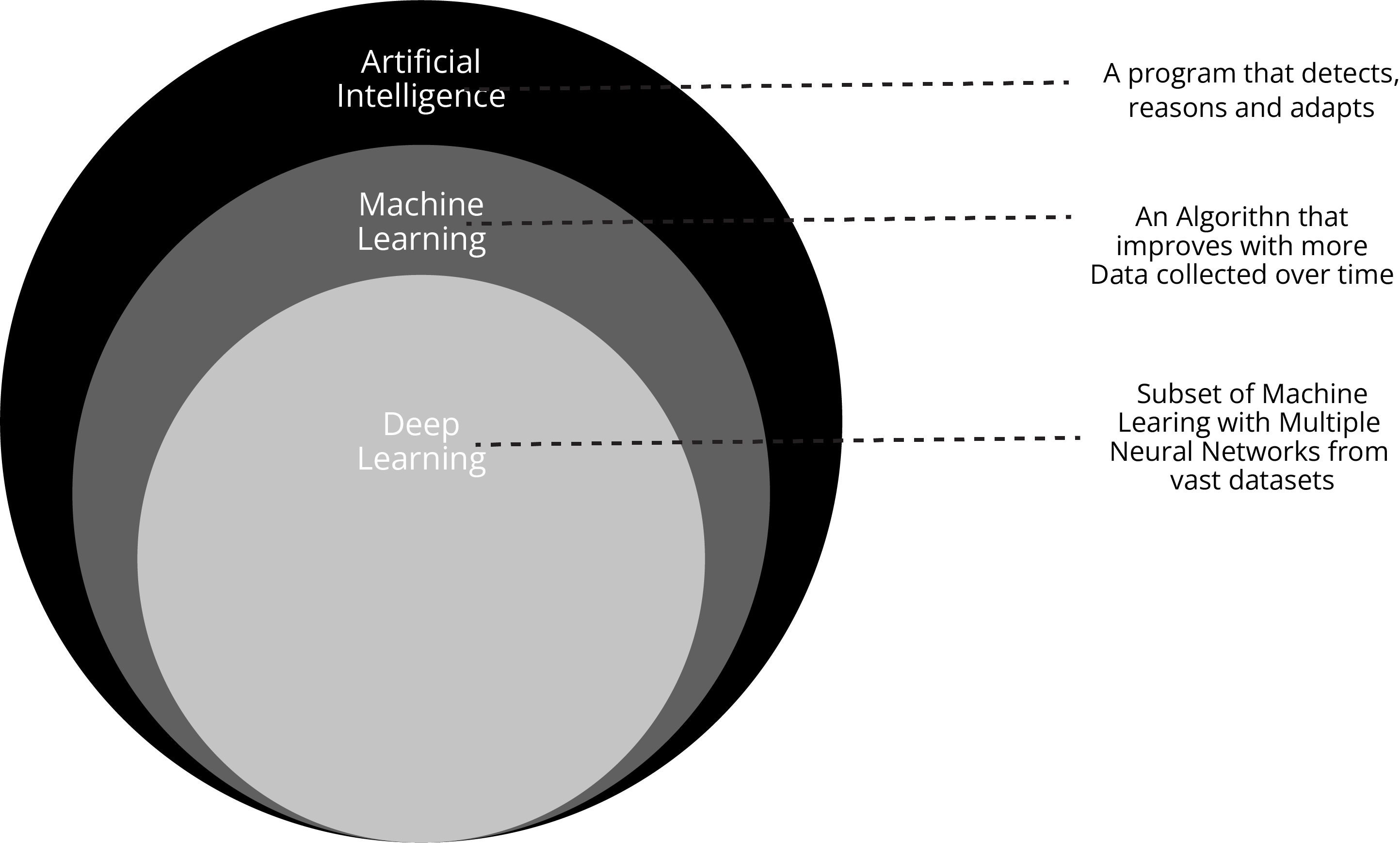
The relationship between Deep Learning, Machine Learning, and Artificial Intelligence
The effectiveness of machine learning, deep learning, and AI systems depends heavily on data scale and quality. These algorithms require substantial datasets to identify patterns, train effectively, and continuously improve through iterative testing.
The
Foreword
577 words
Move Chapter 1-Understanding Machine Learning and AI
Open Chapter 1-Understanding Machine Learning and AI
Understanding Machine Learning and AI
Defining the Current Landscape
Machine learning & Artificial Intelligence has rapidly evolved from an academic concept to a mainstream business tool. Google Trends data reveals exponential growth in search interest since 2004, indicating both early adoption by innovators and recent mainstream acceptance.
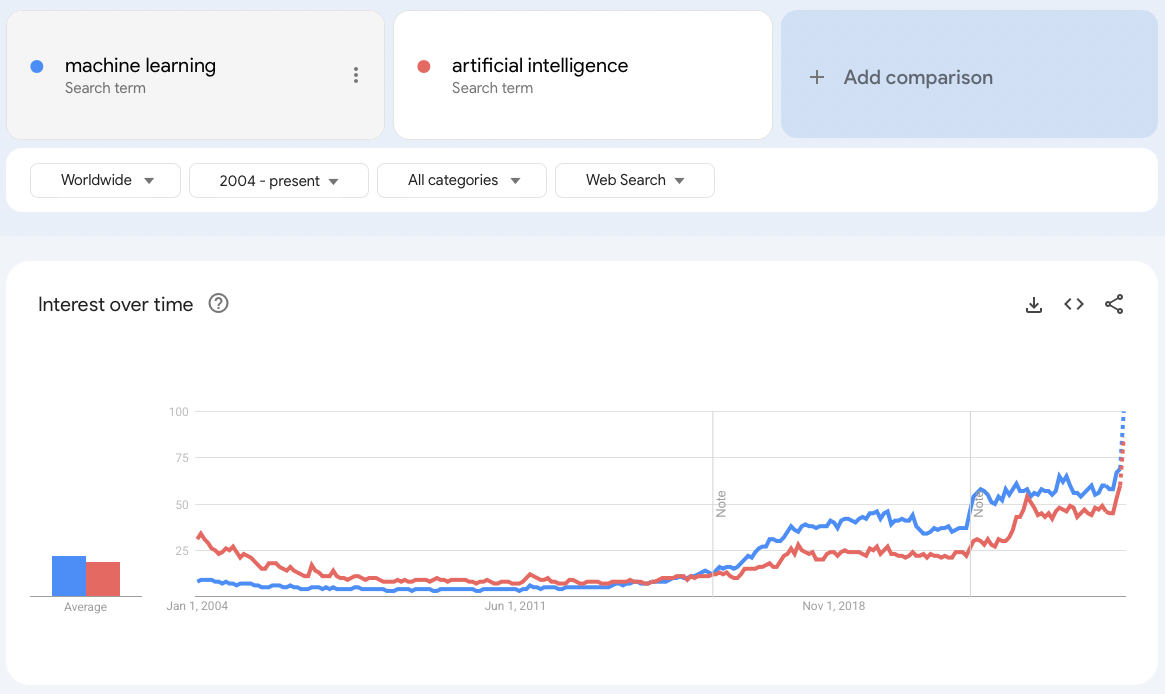
Facets of Machine Learning Surround Us Everywhere
 As a business leader, you likely encounter machine learning applications daily without realizing it. Netflix's content recommendations, Spotify's music suggestions, and even medical diagnostics using retinal imaging for cardiovascular risk assessment all demonstrate machine learning as examples in practical application.
What is Machine Learning?
So how do all of these companies make intellige
Chapter 1-Understanding Machine Learning and AI
1,143 words
Move Chapter 2-The Four Types of Machine Learning
Open Chapter 2-The Four Types of Machine Learning
The Four Types of Machine Learning
Before you start working on implementing a Machine Learning model for your business problem, the first task that you need to do is “Define your Objective”. The objective here refers to the purpose of implementing the Machine Learning model and the result that you are expecting. The objective will help you to collect relevant data and decide on the appropriate method to be used.
Implementation of a Machine Learning model is not a very difficult task, but we need to decide which Model will give the best result. Normally we use a model based on data available or provided to us. Your task will be easier in selecting a model if you know about the different types of Machine Learning models.
There are four key types or stages of Machine Learning:
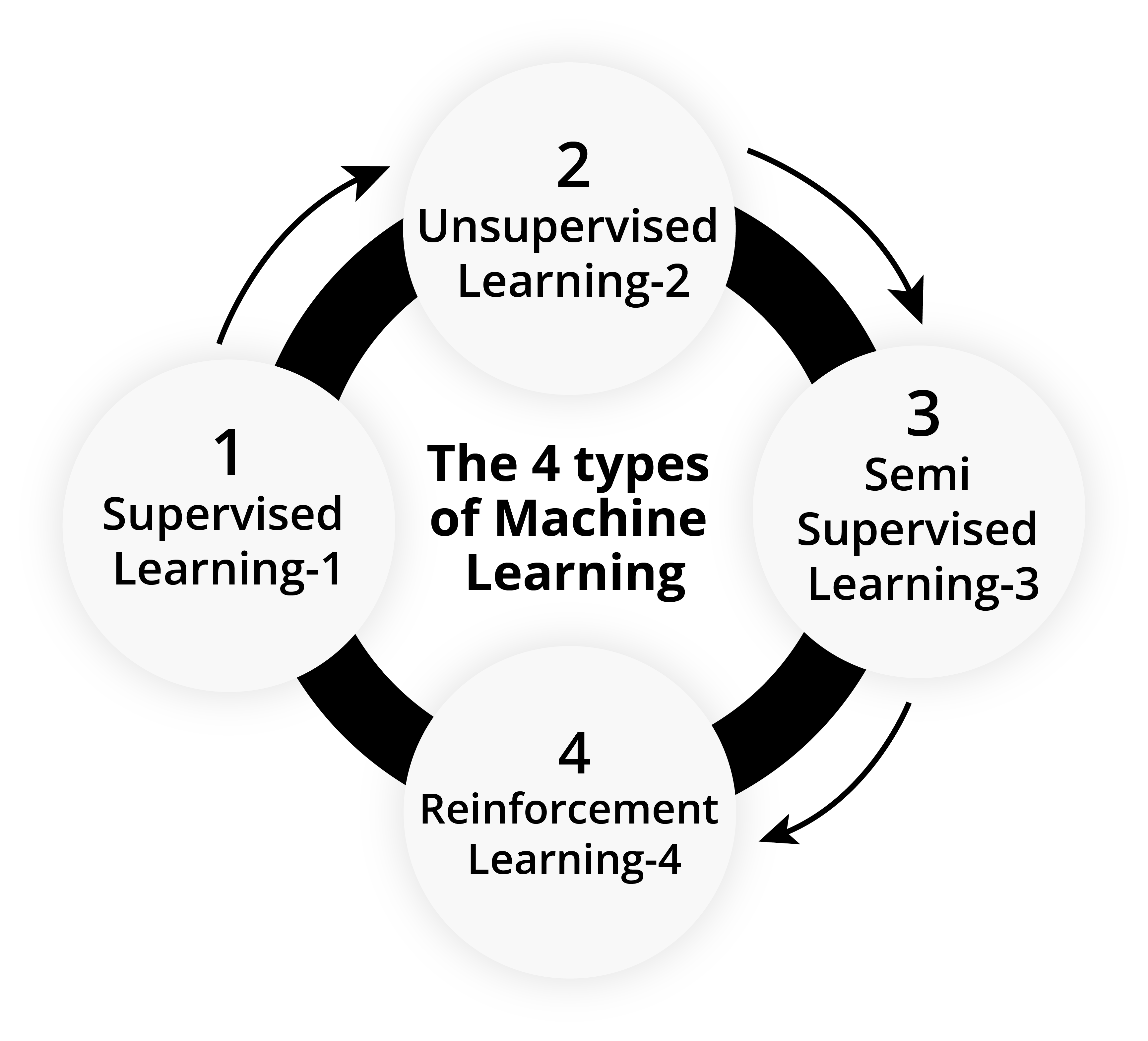
The 4 stages of Machine Learning
Machine learning models fall into four main categories as depicted above. Based on the type of data we have and the research prob
Chapter 2-The Four Types of Machine Learning
1,771 words
Move Chapter 3-Commonly used Algorithms
Open Chapter 3-Commonly used Algorithms
Commonly used Algorithms
Machine Learning is used by different companies in multiple industries to solve their business challenges. The main reason for selecting Machine Learning algorithms over traditional algorithms is the accuracy in prediction they provide. Machine Learning helps in building a model which can produce a highly accurate model which further improves itself with an increase in training data.
Each of the four main types of Machine Learning can use a variety of algorithms. A summary of these main algorithms is provided below, along with some business use cases.
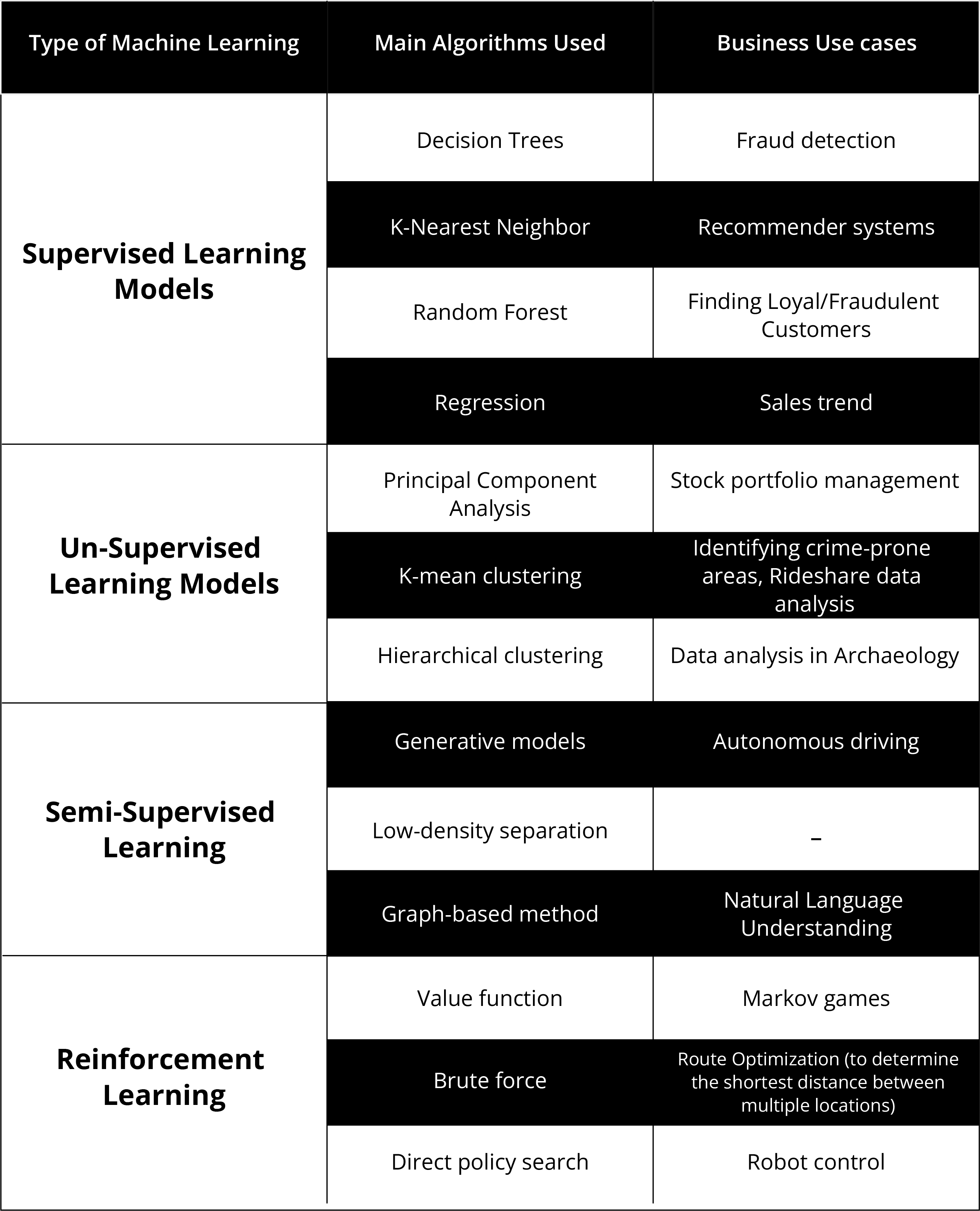 Main Machine Learning Algorithms and Some Key Business Use Cases
Supervised Learning Models
As we know Supervised learning models are used for labelled data and for regression and classification problems. A wide range of supervised learning algorithms are available, and each one comes with its inherent strengths and weaknesses.
Classification Algori
Chapter 3-Commonly used Algorithms
3,005 words
Move Chapter 4-Best Practices for Machine Learning
Open Chapter 4-Best Practices for Machine Learning
Best Practices for Machine Learning
We have seen different algorithms in the last chapter and understood their significance as well. But before implementing Machine Learning for your “Business Objective”, we should suggest following the best practices used by the industry. These will help in avoiding any mistakes and ensure an error free implementation of Machine Learning.
We can identify the best practices for Machine Learning in the following manner:
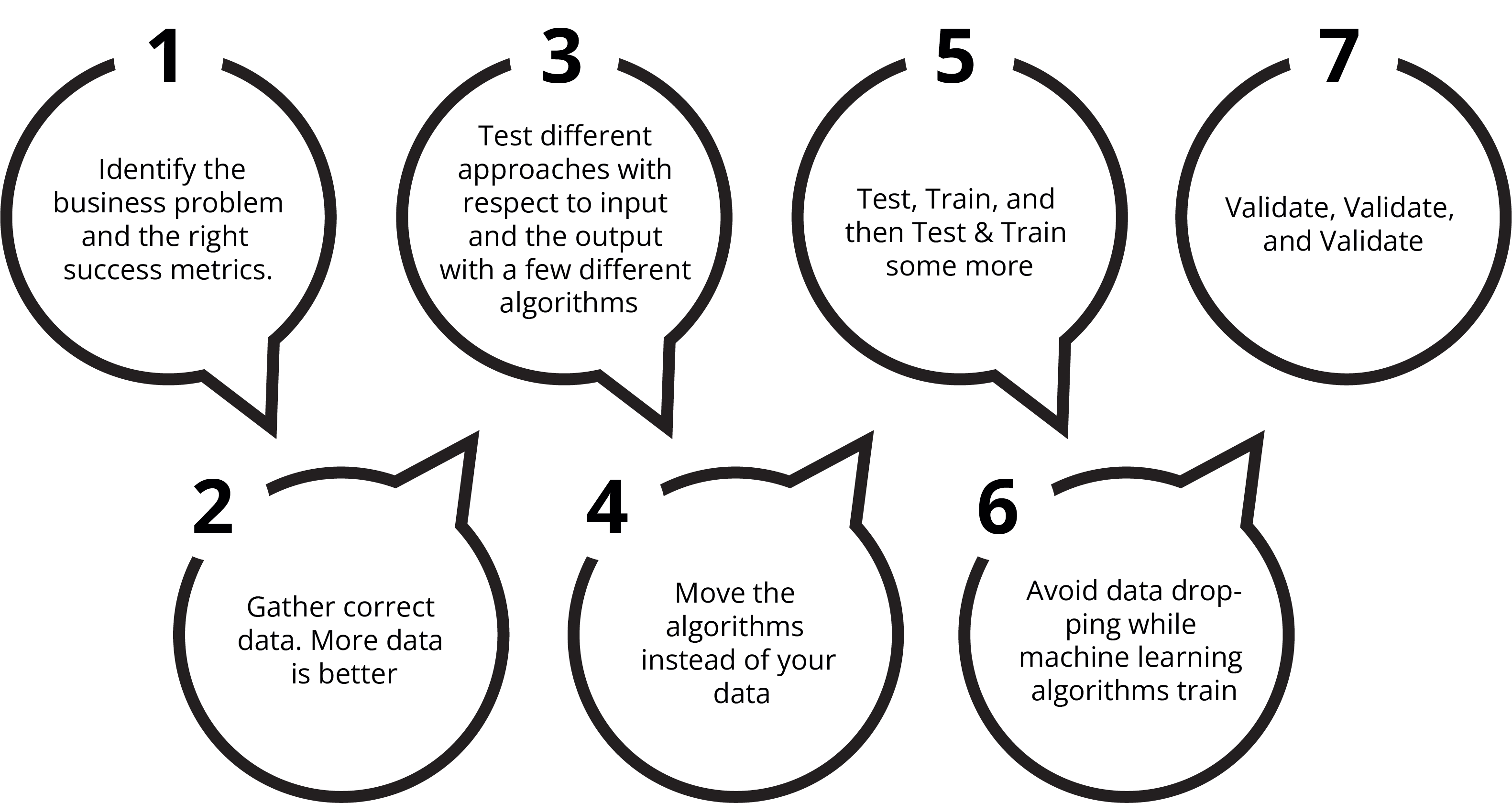
Most Machine Learning programs follow the above lifecycle. Machine Learning, like any other business capability, is primarily driven by a business problem. As a first activity, we have to convert this business problem into a Problem Statement and identify KPIs (Key Performance Indicator) to measure the outcome.
We need to make a list of relevant data points based on the Problem Statement and collect these data elements. The data points should be collected from trusted and reliable sources
Chapter 4-Best Practices for Machine Learning
2,662 words
Move Chapter 5-Make your organization Machine Learning ready.
Open Chapter 5-Make your organization Machine Learning ready.
Make your organization Machine Learning ready.
We know that Machine Learning contributes significantly to organizational growth. The organization, its stakeholders, employees, and management all have to learn and contribute to the implementation of Machine Learning models. We have prepared a checklist which can help you to prepare yourself and your team for Machine Learning implementation.
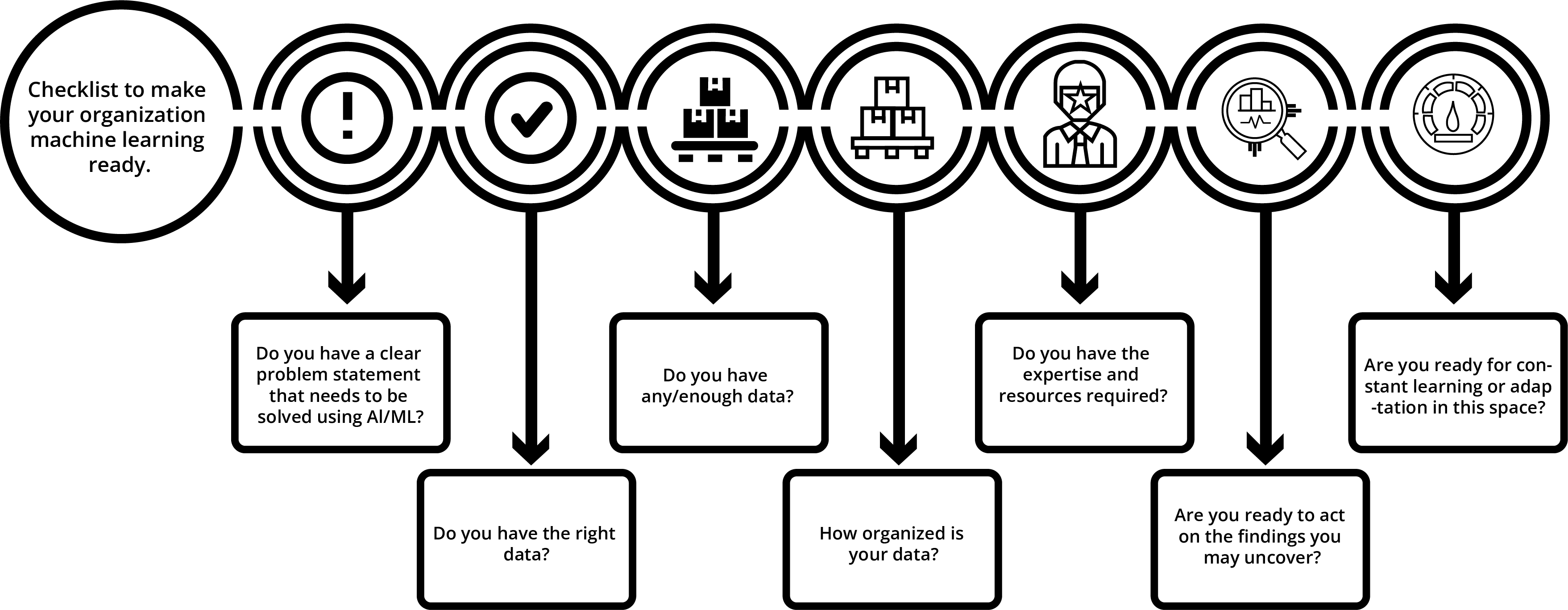 Visual Checklist to determine if your organization is ready for Machine Learning
Do you have a clear problem statement that needs to be solved using AI/ML?
Machine Learning is mostly used for prediction and clustering purposes. So, the first step is to identify the problem statement that may equate to something like “what you want to predict?” or “How many clusters do you want to create”.
Organizations need to have a clear problem statement to utilize machine learning.
For example- which customers are responding to the promotional offers
Chapter 5-Make your organization Machine Learning ready.
2,982 words
Move Chapter 6-Deep Learning & Neural Networks
Open Chapter 6-Deep Learning & Neural Networks
Deep Learning & Neural Networks
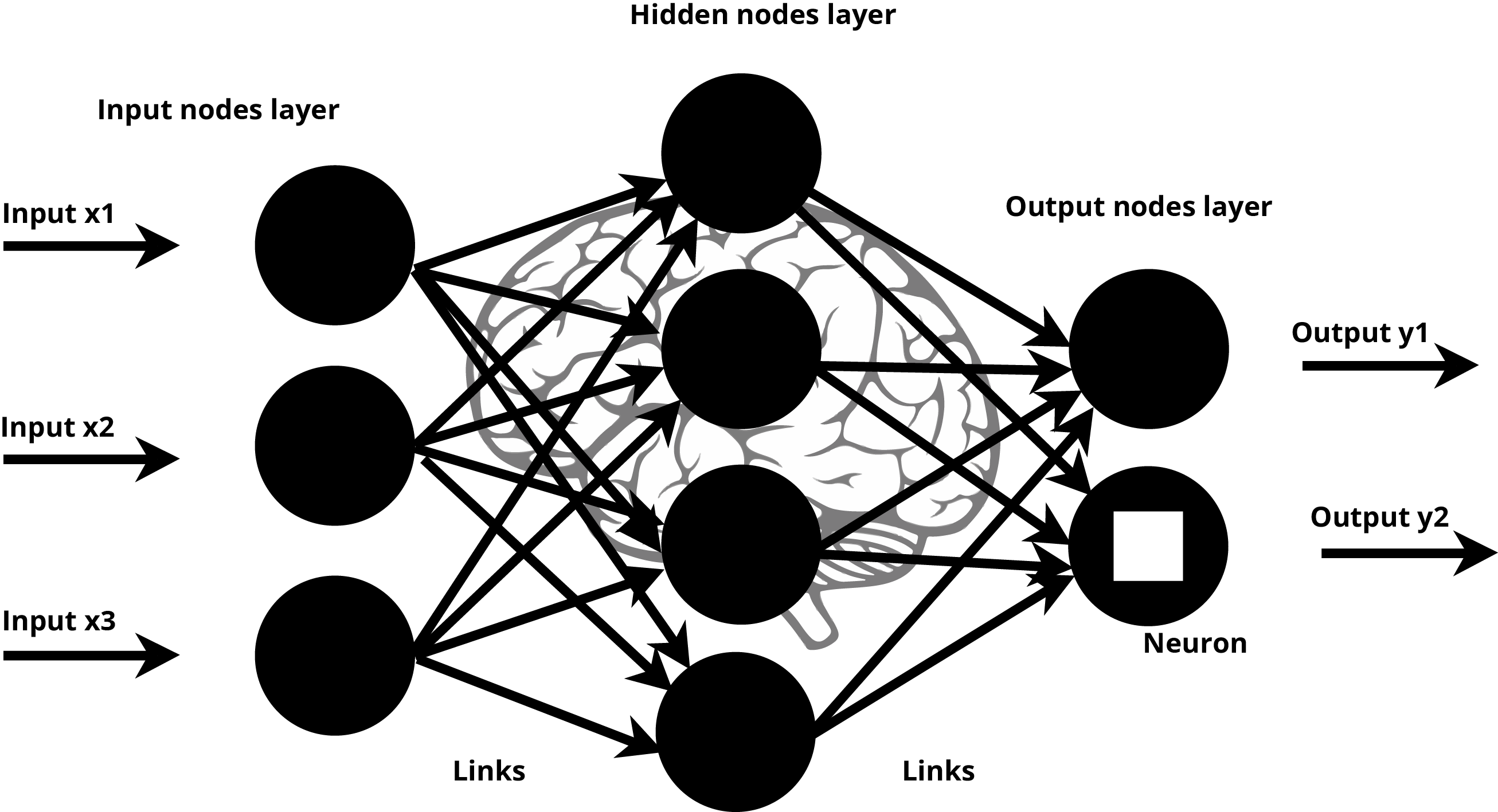
Visual Representation of a Neural Network
Deep Learning is a subfield of Machine Learning which makes high performing prediction models. Deep Learning uses Neural Network architecture with multiple hidden layers which is inspired by the structure of the human brain. In a human brain, the neurons form the fundamental building blocks of the brain and transmit electrical pulses throughout our nervous system, and the perceptrons receive a list of input signals and transform them into output signals.
Deep Learning is based on artificial neural networks and was built by experts to mimic the working of the human brain. Similar to how humans learn from experience, deep learning algorithms learn from iterative experience. Every time a network performs the task, it learns and adds the learnings of the approach it undertook to its memory. Over time, with increased practice it makes it possible for it to improve itsel
Chapter 6-Deep Learning & Neural Networks
2,876 words
Move Chapter 7-Myth Buster Section
Open Chapter 7-Myth Buster Section
Myth Buster Section
In this chapter, we are going to discuss 7 Machine Learning myths that are misconceptions and need to be cleared up.
Myth 1: Machine Learning can do anything with massive amounts of data
There is a general perception regarding the data for ML, which is “the more, the better”. Although we have discussed in our previous chapters about the amount of data we may need, we also mentioned the importance of having “relevant and clean” data.
We need sufficient data and high processing power systems for our ML model to train, so that it produces a model with a high degree of accuracy when it comes to prediction. Specifically, Deep Learning models and NLP models require millions of records to be trained. But these data elements must be relevant and clean, otherwise, our ML model will be unable to generate the result that we are expecting.
There isn't going to be any significant positive impact on your ML model if the data is messy and irrelevant to the problem at hand. Sometime
Chapter 7-Myth Buster Section
1,171 words
Move Untitled
Open Untitled
Programming Languages Used for Machine Learning
When you are planning to build AI and ML models for your business process, it is very important to select the right programming language after deciding the business objective and relevant data.
One of the significant factors in deciding the programming language for your machine learning is the end goal of your project. Here we will discuss the main programming languages that can be used for Machine Learning, along with the associated use cases to see the effectiveness of each in different domains.
Python
Python is one of the most prominent languages to be used in machine learning. Python is an open-source language that has a relatively easier syntax than other languages. You can implement classes, modules, objects with remarkable ease. 57% of data scientists prefer using Python in machine learning.
What could be the reason for its popularity? The answer lies in its tools and libraries for the machine learning framework.
NumPy and Pandas
Untitled
997 words
Move Chapter 9-Infrastructure for AI/ML
Open Chapter 9-Infrastructure for AI/ML
Infrastructure for AI/ML
The biggest challenge an organization faces while adopting Machine Learning is the infrastructure cost. As we have seen, we need a significant amount of data and high-powered processing systems for Machine Learning and self hosted AI applications. The ideal solution for this is the Cloud Environment. Investing money in dedicated hardware, infrastructure and skilled personnel is not an option that most organizations have.
Gordon Moore, the founder of Intel, made a famous prediction in 1965, which is known as Moore’s Law. He stated that:
‘The complexity for minimum component costs has increased at a rate of roughly a factor of two per year. Certainly, over the short term, this rate can be expected to continue, if not to increase. Over the longer term, the rate of increase is a bit more uncertain, although there is no reason to believe it will not remain nearly constant for at least 10 years.’
The essence of Moore’s Law is that with each passing year, the cost of computi
Chapter 9-Infrastructure for AI/ML
1,198 words
Move Chapter 10-LLMs, Agents and What Comes Next
Open Chapter 10-LLMs, Agents and What Comes Next
LLMs, Agents and What Comes Next
The rise and adoption of LLMs (Large Language Models) which in some ways an extension of neural networks has been mindboggling:
In just 5 days post launch, ChatGPT crossed 1 million users.
Two months after launch ChatGPT had 100 million users.
After 9 months since launch ChatGPT has reached 180.5 million users.
And of course these numbers do not take into account the number of users that may be using ChatGPT inside a third party product that taps into the OpenAI API or is using one of the many other LLMs.
What is a LLM?
A LLM is an Neural Network model that has trained itself on a large corpus of data (billions of parameters) and has achieved general language understanding and generation capabilities. The LLMs use statistical models and learn the relationship between words and phrases. And that is why when we interact with them, we get visions of AGI (Artificial General Intelligence, where a machine thinks like a human).
This pattern recognition
Chapter 10-LLMs, Agents and What Comes Next
3,069 words
Move Chapter 11 - The AI Advantage
Open Chapter 11 - The AI Advantage
So What is the AI Advantage?
In a single phrase, the AI Advantage is “workflow automation”.
From a musician, programmer, film maker, someone that works on drug discovery, a teacher, a student or any one that has some kind of work flow in their job, everyone will be working with aspects of AI powered workflow automation very soon.
1. MCP (Model Context Protocol)
As mentioned before, MCP’s are a key standard that will allow non-technical users to be able to use natural language to interact with various systems.
An example that many of us in the business world can easily understand would be to see the Google Analytics MCP in action. Watch this short video to get an understanding of where we are headed https://www.youtube.com/watch?v=PT4wGPxWiRQ
Imagine MCPs for all the major platforms we interact with on a daily basis. Extending this even further, imagine an environment where you can interact with multiple systems via multiple MCPs via a single prompt or series of prompts.
2. Cri
Chapter 11 - The AI Advantage
483 words
Move Legal Disclaimer
Open Legal Disclaimer
Legal Disclaimer
This publication is designed to provide general information about machine learning and artificial intelligence for business leaders. It is not intended to provide legal, financial, technical, or professional advice. The information contained herein is current as of the publication date and may become outdated due to changes in technology, regulations, or market conditions.
The authors make no representations or warranties regarding the
accuracy, completeness, or suitability of the information contained herein.
Readers should consult qualified professionals before making business, technical, or legal decisions based on this information.
The use of company names, product names, and trademarks is for identification and educational purposes only and does not imply endorsement by or affiliation with those companies.
Results may vary based on individual circumstances, and past performance does not guarantee future results. The authors and publishers disclaim any liability for deci
Legal Disclaimer
153 words
Move Technical Disclaimer
Open Technical Disclaimer
Technical Disclaimer
The technology landscape for machine learning and artificial intelligence evolves rapidly. Information about specific technologies, platforms, and performance characteristics may become outdated quickly. Readers should verify current capabilities and limitations with appropriate vendors and technical experts before making implementation decisions.
Performance metrics and comparisons are based on available information at the time of publication and may not reflect current capabilities or optimal configurations for specific use cases.
Technical Disclaimer
64 words