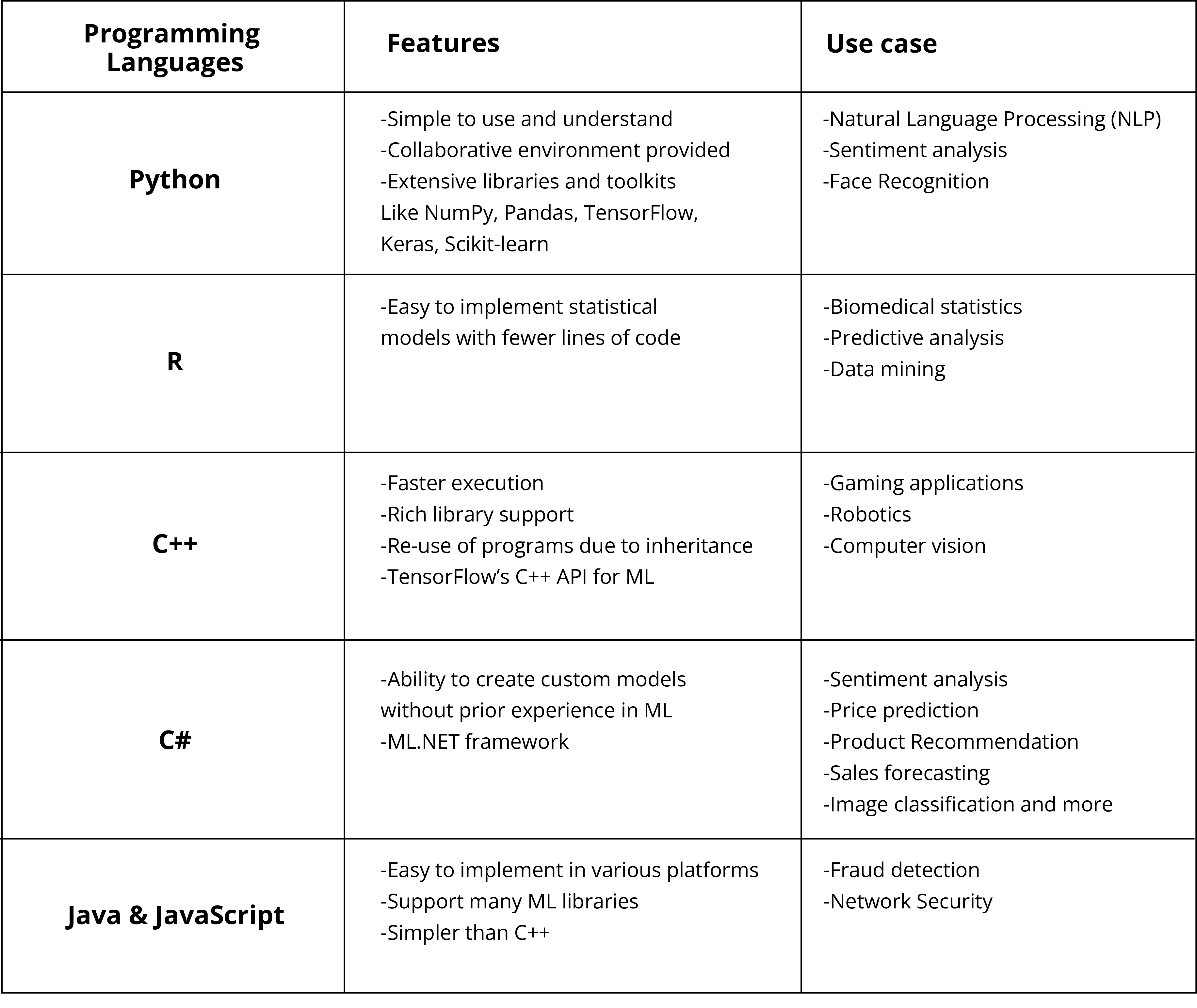
Programming Languages Used for Machine Learning
When you are planning to build AI and ML models for your business process, it is very important to select the right programming language after deciding the business objective and relevant data.
One of the significant factors in deciding the programming language for your machine learning is the end goal of your project. Here we will discuss the main programming languages that can be used for Machine Learning, along with the associated use cases to see the effectiveness of each in different domains.
Python
Python is one of the most prominent languages to be used in machine learning. Python is an open-source language that has a relatively easier syntax than other languages. You can implement classes, modules, objects with remarkable ease. 57% of data scientists prefer using Python in machine learning.
What could be the reason for its popularity? The answer lies in its tools and libraries for the machine learning framework.
NumPy and Pandas are popular libraries that perform mathematical functions like linear algebra, extraction and manipulation of datasets. It is used for handling structured data, images and sounds.
Scikit-learn library supports different ML algorithms such as Decision Trees, Ensemble Learning, KNN, SVM, clustering and dimension reduction such as PCA.
TensorFlow is another excellent environment for handling and training deep neural network algorithms. It can be used on a wide range of platforms, including desktops, phones, and servers. It includes Keras libraries for building models such as ANN, CNN, RNN LSTM and many more.
Potential Use Case
Due to the wide variety of specialized libraries, and simple-to-understand syntax, Python is used for all types of ML algorithms and even in Natural Language Processing (NLP) and sentiment analysis. Voice assistants like Amazon’s Alexa, Apple’s Siri, and social media features of face recognition have been built using Python.
R
R is another popular and powerful language used by data miners and statisticians around the world and provides support for operating systems like Windows, Linux, and OS X. It is an open-source, object-oriented, and dynamic language. It has LaTeX-like documentation (LaTeX is the de facto standard for the communication and publication of scientific documents) which helps the user to write programs. R provides different modules for advanced functions of statistical and graphical analysis. R module GGPLOT2 is used for graphical analysis. Some of the machine learning packages used in R include CARET, KernLab, Rpart, and the interface for TensorFlow.
R studio is a GUI interface to write and execute programs. And R Markdown can be used for adding text messages, program results embedded within the program. We have options to save multiple R projects as ‘.rdata’ or ‘.rda’. Later on, we can use this file to extract data as well. Another file .rds is used for single R projects.
Potential Use Case
R finds its applications in data mining, predictive analysis, and biomedical statistics. Several other languages for artificial intelligence development include Lisp, Ada, Julia, Go, Shell and Prolog, but not many people are well-acquainted with these.
C++
C++ is the second most widely used programming language, with 43% of data scientists preferring it over others. This language is a low-level language compared to java meaning the machines can read the code more clearly than humans. That is why it has a faster run time as well. Most Data Scientists prefer Python for easier syntax but C++ is also preferred for faster execution even with larger datasets. C++ also provides a rich library support through STL (Standard Template Library). Tensorflow C++ API is used in the backend in many ML applications for faster computations.
The machine learning developers have a goal to focus on, and they do not want to get stuck in the intricacies of the code. That is why C++ is not preferred by many for development as compared to Python. C++ does not provide a collaborative environment like Python does. Jupyter Notebooks and Google Colab are interactive environments designed in Python where users can learn and share their code easily.
Potential Use Case
The task-specific algorithms in AI use C++, for example, in gaming applications, robotics, and computer vision.
C# (pronounced C Sharp)
C# is also a versatile programming language that is simple, object-oriented, and open-source. Programmers can build applications like Windows clients, mobile apps, web applications, and consoles. It is among the top 5 programming languages used in ML.
C# is used in machine learning via ML.NET framework, which comes with exclusive packages like TensorFlow. It allows developers to fuse their custom-created models and algorithms into applications using .NET, even if you do not have a strong experience in machine learning.
ML.NET is a machine learning framework for .NET(C#) developers. It can be used for various ML projects such as scenario analysis, product price prediction, product recommendation, sales forecast and many more.
Potential Use Case
Using C#, in deep learning, is not easy as it has no toolkits available for this purpose. You need to have a deep understanding of this language before implementing your model as it is a bit more complex than Python.
Java & JavaScript
Java closely resembles C/C++ in its syntax and also follows object-oriented principles. It is also easily implemented on various platforms. Some of the Java libraries for the machine learning framework include JavaML, ADAMS (Advanced Data Mining and Machine Learning System), and Deeplearning4j.
JavaML provides a simple implementation environment for machine learning algorithms. The ADAMS library helps control the data flow in a tree-like structure to manage the workplace. Deeplearning4j is another popular library that provides support for handling deep neural networks. It is commonly used for finding patterns in speech and text and detecting anomalies in fraud detection. Java is, however, slower than C++.
JavaScript is a web scripting language, and many machine learning libraries support JavaScript.
Potential Use Case
Java is a more enterprise-focused ML language. It is used to build applications in financial institutions, mostly for fraud detection and network security.